


Enterprise blockchain adoption doesn’t get limelight overnight, but Hedera today added another piece to a much bigger puzzle. The network has integrated with Utila, which is known as an institutional grade digital asset custody and wallet infra provider.
By joining hands they are expanding secure access to HBAR and Hedera Token Service (HTS) tokens for enterprises operating at scale.
The partnership arrives as Hedera continues building its presence across regulated financial markets, where security, compliance, and operational control often matter more than hype.
Utila Brings Institutional-Grade Infrastructure
Utila enters the collaboration with solid credentials. The platform has secured $51.5 million in funding and processes more than $200 billion in transaction volume, offering Multi-Party Computation (MPC) wallets, customizable policy controls, and enterprise-focused APIs.


For organizations managing HBAR and HTS tokens, the integration introduces compliance-focused custody infrastructure. Which is designed to simplify digital asset operations without compromising security. That lowers the entry barrier for financial institutions seeking blockchain exposure within regulated environments.
Project Acacia Expands Hedera’s Reach
The integration extends beyond custody services. Utila is serving as a key infrastructure provider for project Acacia, the Reserve Bank of Australia’s digital money pilot, alongside Hashgraph and Hashsphere. The initiative operates on a private network powered by Loading profile preview technology, placing the blockchain within a high-profile state-backed financial experiment.
That role reinforces Hedera’s growing reputation as infrastructure capable of supporting enterprise and government-level blockchain deployments.
Network Activity Continues To Scale

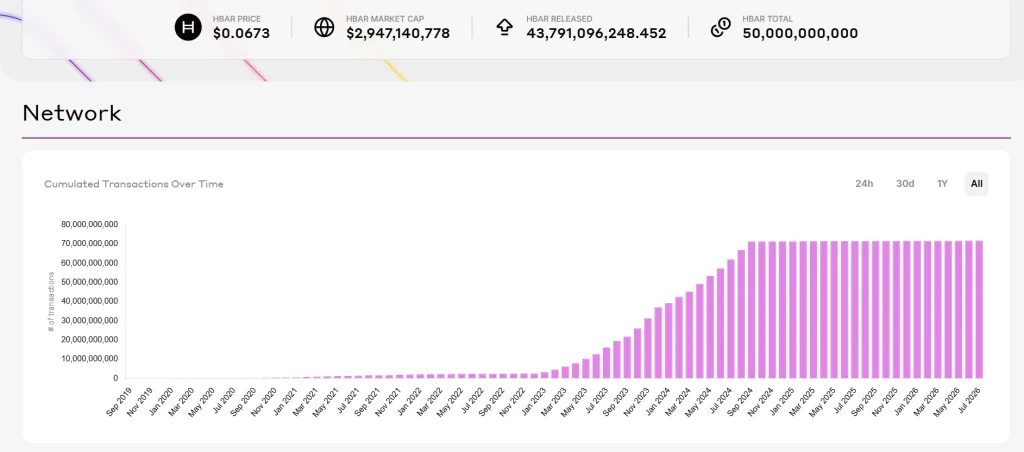
Moreover, the latest partnership follows another notable development for Hedera. Per onchain data the rising graph shows increases in transaction counts. Per chart, it is approaching 72 Billions in cumulative transactions count that has been processed across its network.
That figure highlights sustained enterprise usage rather than isolated bursts of activity. As transaction volumes continue growing, Utila integration appears less like an optional upgrade and more like a necessary step.
For Hedera, enterprise adoption isn’t being measured by announcements alone. It’s increasingly being backed by transaction volume, regulated infrastructure, and participation in large-scale financial initiatives.
Loading article prices
Was this writing helpful?
Story Ends Here
Trust with CoinPedia:
CoinPedia has been delivering accurate and timely cryptocurrency and blockchain updates since 2017. All content is created by our expert panel of analysts and journalists, following strict Editorial Guidelines based on E-E-A-T (Experience, Expertise, Authoritativeness, Trustworthiness). Every article is fact-checked against reputable sources to ensure accuracy, transparency, and reliability. Our review policy guarantees unbiased evaluations when recommending exchanges, platforms, or tools. We strive to provide timely updates about everything crypto & blockchain, right from startups to industry majors.
Investment Disclaimer:
All opinions and insights shared represent the author’s own views on current market conditions. Please do your own research before making investment decisions. Neither the writer nor the publication assumes responsibility for your financial choices.
Sponsored and Advertisements:
Sponsored content and affiliate links may appear on our site. Advertisements are marked clearly, and our editorial content remains entirely independent from our ad partners.
Read the Next News






Kommentar hinterlassen