

Key Takeaways
- The Sensex fell 2.15% on July 8 before recovering as Indian mutual funds bought the dip.
- UPI processed 241.6 billion transactions in FY 2025-26, per NPCI, cementing India’s payments lead.
- The RBI continues urging banks to avoid crypto exposure even as 39 million Indians hold digital assets.
A Sharp Drop, a Fast Recovery
The Sensex fell 1,677 points on July 8, a 2.15% drop, after renewed fighting between the United States and Iran ended a fragile truce. India’s Sensex serves as the benchmark equity index of the Bombay Stock Exchange (BSE), measuring the performance of 30 of the country’s largest and most actively traded companies spanning the principal sectors of the Indian economy.
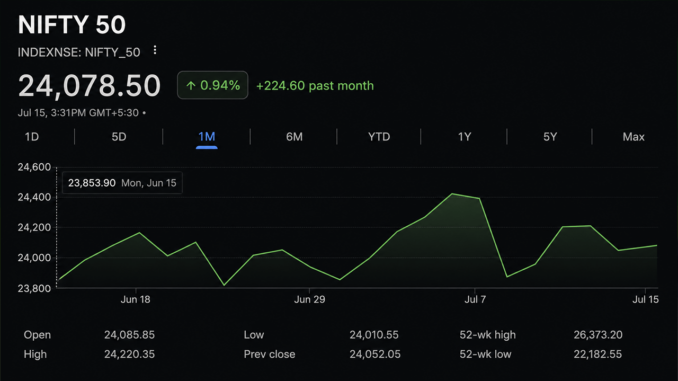
The Nifty 50 lost 516 points that day, closing at 23,882.05. Basically, the Nifty 50 is the benchmark index of India’s National Stock Exchange, tracking the performance of the country’s 50 largest and most influential publicly traded companies. Crude oil jumped roughly 6% on the news, and India’s currency weakened to about 95.5 rupees per dollar.

Two days later, the market turned around fast. On July 10, the Sensex gained 828 points and the Nifty rose to 24,207, lifted by banking stocks and early optimism around first-quarter earnings. By July 15, the Nifty was testing levels above 24,190 after softer U.S. inflation data raised hopes for a more dovish Federal Reserve.
Domestic Buyers Step In When Foreigners Sell
Foreign institutional investors sold heavily during the two-week stretch, including a net outflow of about 3,062 crore rupees on July 13. Indian mutual funds and other domestic institutions bought through the selloff, adding roughly 2,000 to 3,000 crore rupees on most trading days. That buying kept the market from a deeper slide.
- July 8: Sensex falls 2.15%, Nifty falls 2.12%.
- July 10: Sensex gains 1.08%, Nifty gains 1.02%.
- July 14: Domestic institutions buy 2,928 crore rupees as foreign investors sell.
Financial stocks, including Bajaj Finance, Axis Bank and State Bank of India, led the recovery. Information technology and metals stocks lagged on several sessions as oil prices stayed elevated.
Payments at a Scale Few Countries Match
Away from the stock swings, India’s digital payment system continues to grow by leaps and bounds. The Unified Payments Interface (UPI) processed 241.6 billion transactions in the 2025-26 fiscal year, worth more than 314 lakh crore rupees, according to National Payments Corporation of India data. The International Monetary Fund (IMF) has said UPI accounts for close to half of all real-time payment transactions worldwide.
More than 731 million UPI QR codes are now in use, letting street vendors and small shops accept digital payments without card machines. Roughly two dozen countries are studying or adapting India’s payment model, often referred to as the India Stack, for their own systems.
Chips, Youth, and a Growth Bet
India’s government has expanded its semiconductor push well beyond its original $10 billion mission. Recent approvals have added more than 1.25 lakh crore rupees, about $15 billion, in incentives for chip fabrication, packaging, and design. Tata Electronics is building a fab in Gujarat with partner Powerchip, part of 12 approved semiconductor projects across the country.
NITI Aayog, the government’s policy think tank, has set a target of capturing 10% to 13% of the global semiconductor market by 2035, tied to a projected $120 billion to $150 billion value chain. The bet is backed by demographics. India’s population of about 1.48 billion includes a working-age share of 66% to 68%, a base the IMF cites as a core reason the country is expected to grow 6.4% in the 2026-27 fiscal year, well above the global average.
With 39 Million Users, Crypto Assets Like Bitcoin Still Face a Wall of Caution
India taxes gains on virtual digital assets at a flat 30%, with an added 1% tax deducted at source on transfers. About 54 crypto service providers are registered with the country’s financial intelligence unit, serving 39 million verified users who hold roughly $2.1 billion in assets.
The Reserve Bank of India has repeatedly told Parliament it favors policies that lean toward prohibition for private cryptocurrencies and stablecoins, urging banks to avoid exposure to protect financial stability. A long-promised crypto bill remains unfinished.
At the same time, government agencies are using permissioned blockchain for tasks unrelated to trading. AIIMS Delhi used blockchain to manage faculty recruitment records. The Cotton Corporation of India tracks cotton bales through a blockchain identification system. Aviation regulator DGCA is building a blockchain-linked platform for its digital services.
The split approach lets India use blockchain technology for government record keeping while keeping tight limits on speculative crypto trading. Where that balance goes next depends on whether lawmakers move toward clearer rules or leave the current tax and compliance system in place.






Kommentar hinterlassen